


Bone Loss and Dental Implants: Can You Still Qualify for Treatment?
Basics of implants — strong, natural tooth restoration with a metal post.
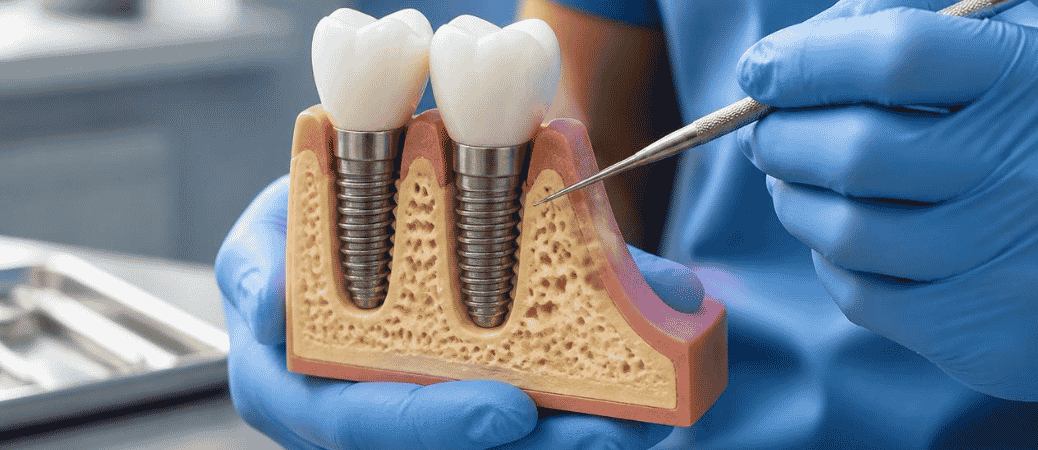
Being told you have bone loss can feel like a closed door. It rarely is.
Bone loss dental implants treatment often requires a different plan rather than ruling out implants completely, and modern imaging makes that decision much clearer than it was a decade ago.
Your jawbone shrinks after tooth loss because it no longer gets the pressure that tooth roots once provided.
That shrinkage affects height, width, and density in different amounts, which is why two people with “bone loss” can end up with very different treatment paths.
A 3D scan, not a guess, decides whether you need a graft, a different implant angle, or a full-arch approach that works around the bone you already have.
With that picture in hand, the team at Arthur Greyf DDS can tell you which options are realistic for your mouth and which are not.
Key Takeaways
- Bone loss usually reshapes your implant plan instead of ending it.
- Grafting, sinus lifts, angled implants, and zygomatic implants each solve a different bone problem.
- A CBCT scan measures your actual bone height, width, and density before anyone promises results.
Can You Still Qualify for Implant Treatment?
Most people with jaw bone loss still qualify for some form of implant treatment.
The question your dentist is answering is not whether you have lost bone, but where the loss is, how much remains, and whether the remaining bone can hold an implant still enough to heal.
Why Implants Need a Stable Bone Foundation
An implant works because bone grows tightly against its surface, a process called osseointegration.
That bond only forms if the implant stays motionless for the first several weeks of healing.
Thin or soft bone lets the implant micro-move under pressure.
Movement during healing is one of the clearest paths to implant failure, which is why surgeons care so much about initial stability at the moment of placement.
The alveolar ridge, the arch of bone that used to hold your teeth, is the part that shrinks first. It carries no load once a tooth leaves, so the body slowly withdraws it.
How Much Bone Is Needed for Implant Placement?
Bone is measured in three ways: height, width, and density.
A standard implant needs enough vertical height to sit safely above the nerve or below the sinus, and enough width so bone surrounds the implant on both sides.
| Bone finding | What it usually means for planning |
| Adequate height and width | Standard implant placement, no graft |
| Narrow ridge, good height | Ridge augmentation or a narrower implant |
| Short height, upper back jaw | Sinus lift or angled implant placement |
| Severe loss across the arch | Full-arch approach or zygomatic implants |
Jawbone density matters too. Soft bone in the upper back jaw heals more slowly than the dense bone at the front of the lower jaw, so healing time is often extended there.
When Bone Loss Changes the Plan Rather Than Ending It
Bone loss shifts the conversation toward which technique fits, and there are several. Some cases need bone added first.
Others need implants placed in a different position or at a different angle so they reach the bone you still have.
A single missing tooth in a thin spot may need a small graft.
A whole arch with widespread loss may skip grafting entirely by using tilted implants anchored in the front of the jaw, where bone tends to hold up best.
If you are weighing several routes, our overview of dental implant solutions explains how each approach fits different situations.
Why Does the Jawbone Lose Bone After Teeth Are Lost?
Jawbone loss starts with the loss of stimulation.
Tooth roots push force into bone every time you chew, and that pressure tells your body to maintain the bone. Remove the root, and the maintenance signal stops.
Bone Resorption After Tooth Extraction
Bone resorption begins within weeks of an extraction and moves fastest in the first six to twelve months.
The ridge narrows before it shortens, which is why width is often the first thing lost.
Socket preservation, a small graft placed into the empty socket at the time of removal, holds the shape of the ridge while it heals.
If you have an extraction coming up, ask about it before the tooth comes out. Our guide to navigating post-tooth care covers what to plan for in those first months.
Bone loss also lets neighboring teeth drift. That drift changes your bite and the space available for a replacement, which is one reason teeth shifting after tooth loss complicates later implant planning.
How Gum Disease and Periodontitis Damage Supporting Bone
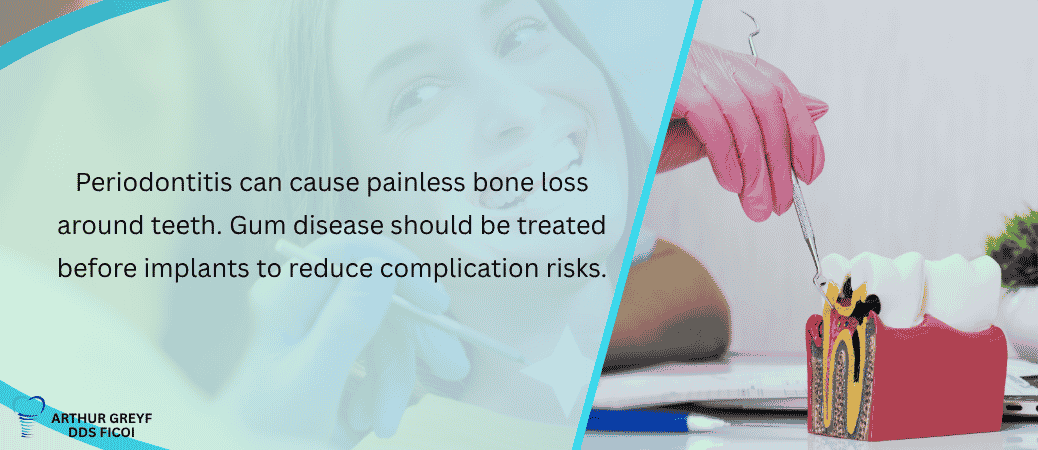
Periodontitis destroys bone while the teeth are still in place.
The infection travels below the gumline and dissolves the bone that anchors the roots, often with no pain to warn you.
That is a different pattern of loss than extraction shrinkage.
Periodontal loss can carve deep craters between roots, so the bone that remains may be tall in one spot and nearly gone in the next.
Active gum disease has to be treated and stabilized before implants go in. Bacteria that damaged natural teeth will attack implants the same way.
Why Long-Term Denture Wear Can Accelerate Ridge Changes
Conventional dentures rest on the gums and press down on the ridge without transferring force into the bone the way roots do. Years of that pressure flatten the ridge.
The sign most people notice first is a denture that keeps loosening. Each reline buys time, then the fit slips again as the ridge continues to change shape.
Other Health Factors That Affect Bone Density
Osteoporosis lowers bone density throughout the body, including the jaw.
It does not automatically disqualify you, though it affects healing time and how your surgeon plans the case.
Smoking reduces blood flow to healing bone.
Uncontrolled diabetes slows healing and raises infection risk.
Certain bone medications, especially IV bisphosphonates, need review with your physician before any surgery.
Which Treatments Can Make Implants Possible?
Several techniques rebuild bone or work around it, and the right one depends on which dimension you are missing and how many teeth you are replacing.
Grafting adds bone volume, sinus lifts create height in the upper back jaw, and tilted or zygomatic implants reach bone in places that never resorbed.
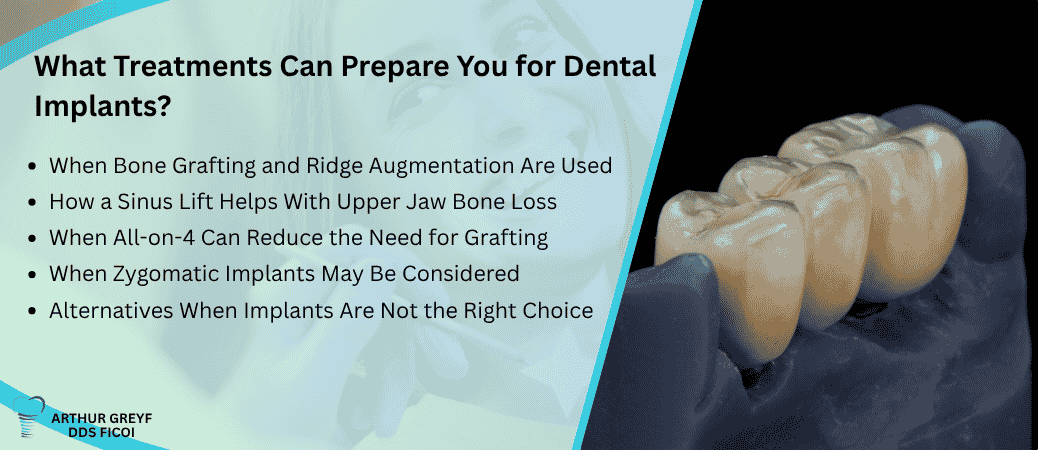
When Bone Grafting and Ridge Augmentation Are Used
Bone grafting rebuilds a ridge that is too thin or too short for a standard implant.
Graft material can come from your own body (autograft), a tissue bank (allograft), or a processed animal source (xenograft), and it acts as a scaffold your own bone grows into.
Guided bone regeneration adds a membrane over the graft to keep gum tissue from filling the space.
For larger defects, a block graft, a solid piece of bone secured with small screws, may be needed.
Healing before implant placement runs 3 to 6 months depending on graft type and size, with the most discomfort in the first three to five days.
Not every case needs one, and our discussion of whether a dental bone graft is always needed walks through when it can be skipped.
How a Sinus Lift Helps With Upper Jaw Bone Loss
The maxillary sinus sits directly above your upper back teeth.
When those molars are lost, the sinus floor drops downward as the ridge shrinks from below, leaving a thin shell of bone between your mouth and the sinus cavity.
A sinus lift gently raises the sinus membrane and places graft material underneath, creating vertical height for an implant.
Two approaches exist: a crestal lift through the implant site for small gains, and a lateral window lift through the side of the jaw for larger ones.
When All-on-4 Can Reduce the Need for Grafting
All-on-4 dental implants use four implants per arch, with the back two tilted to avoid the sinus above and the nerve below.
Tilting lets the implant engage denser bone toward the front of the jaw, where resorption is slower.
That angling is why most patients with moderate bone loss qualify for All-on-4 without grafting, while severe loss may still need grafting alongside placement.
The tradeoff is that this approach replaces a full arch with fixed teeth, so it does not apply to a single missing tooth.
When Zygomatic Implants May Be Considered
Zygomatic implants anchor in the cheekbone rather than the upper jaw.
They are reserved for severe upper jaw bone loss where grafting would be extensive or has already failed.
These are longer implants placed by surgeons with specific training in the technique.
They avoid months of graft healing, though the surgery itself is more involved than standard implant placement.
Alternatives When Implants Are Not the Right Choice
Sometimes implants are not the best fit, and that is a legitimate answer.
Implant-supported dentures using two to four implants can provide far better stability than a conventional denture with less surgery than a fixed full arch.
A traditional dental bridge remains an option when healthy teeth sit on both sides of the gap.
Bridges do not stop ridge resorption underneath, though they restore chewing without surgery.
Our comparison of options for replacing missing teeth lays out how these choices differ in longevity and upkeep.
What Happens During an Implant Evaluation and Recovery?
Your evaluation starts with measurement, not opinion.
A 3D scan, your medical history, and a periodontal exam together determine what is possible, and the surgical plan follows from those findings.
Why a CBCT Scan Is Essential for Planning
A CBCT scan (3D cone-beam CT) shows bone in three dimensions.
Panoramic x-rays and digital x-rays flatten your jaw into a single image, hiding the width of the ridge entirely.
The scan reveals exactly where the inferior alveolar nerve runs through your lower jaw and where the sinus floor sits above your upper teeth.
Research shows that CBCT gives high-resolution 3D visualization of the structures that flat imaging cannot assess, including the buccolingual dimension that decides whether an implant fits.
That data also drives guided implant surgery, where a custom surgical guide transfers the digital plan to your mouth.
At Arthur Greyf DDS, the scan is reviewed with you so you can see your own bone rather than take the measurements on faith.
Choosing an Implant Specialist or Oral Surgeon
Bone grafting, sinus lifts, and complex implant cases typically require an oral surgeon, and periodontists complete three additional years of training focused on bone and gum tissue.
Ask how many cases like yours the provider has treated, whether they place and restore implants or coordinate with another office, and what the plan is if bone turns out to be thinner than expected during surgery.
Can Grafting and Implant Placement Happen Together?
Yes, in many cases. Small grafts placed at the same visit as the implant are common when the ridge needs modest widening and the implant still achieves good initial stability.
Larger defects call for staged treatment: graft first, heal three to six months, then place the implant.
Trying to do too much at once risks losing both the graft and the implant.
Healing Time, Osseointegration, and Final Teeth
Osseointegration takes roughly three to six months for a single implant, longer in softer upper-jaw bone.
Full-arch cases often receive a temporary fixed bridge the same day, with final teeth delivered after integration.
Swelling and soreness peak in the first few days. Our walkthrough of what to expect during tooth implant recovery covers the day-by-day timeline and when to call about symptoms.
What Can Raise the Risk of Implant Failure?
Smoking, uncontrolled diabetes, and untreated gum disease top the list. Peri-implantitis, bone loss around a placed implant, is the most common long-term threat: a Swedish study of over 4,700 implant patients found 14.5% had moderate to severe peri-implantitis at nine years.
Daily oral hygiene and professional cleanings keep that risk down. Dr Arthur Greyf reviews your maintenance schedule at placement.
And our guidance on care after a dental implant covers the cleaning tools that reach around implant surfaces.
A CBCT-Guided Plan Can Preserve Your Options

Bone loss narrows the field of choices without closing it.
A CBCT scan tells you which dimension you are short on, and that measurement points toward bone grafting, a sinus lift, angled full-arch implants, or implant-supported dentures.
Treating gum disease first and committing to daily oral hygiene protects whatever bone you still have.
Both steps support implant success long after the surgery is finished.
If a previous provider told you there was not enough bone, a fresh 3D assessment is worth getting.
Frequently Asked Questions
Can you get dental implants with severe bone loss?
Often yes, though severe bone loss usually requires added procedures such as block grafting, a sinus lift, or zygomatic implants.
The treatment path depends on whether the loss is in height, width, or both, and which jaw is affected.
A CBCT scan is the only way to know which option applies to you.
Can I get dental implants if I have osteoporosis?
Osteoporosis does not automatically rule out implants.
It can slow healing and affect bone density, so your dentist will review your medications, especially bisphosphonates, with your physician before surgery. Extended healing time is common in these cases.
Can you have implants with 50% bone loss?
Fifty percent bone loss around a natural tooth often means that tooth cannot be saved, but the site may still support an implant after grafting.
What matters is how much bone height and width remain after the tooth is removed and the area heals. Your surgeon measures this on a 3D scan before committing to a plan.
How long does bone grafting take before dental implants?
Most grafts need three to six months of healing before an implant is placed. Small socket preservation grafts sit at the shorter end, while block grafts and large sinus lifts take longer.
Some minor grafts are done at the same appointment as the implant.
What causes bone loss around dental implants?
Peri-implantitis, a bacterial infection of the tissue around an implant, is the main cause.
It develops from plaque buildup, and risk rises with smoking, uncontrolled diabetes, and skipped cleanings.
Caught early, it can be treated before the implant becomes loose.
Are zygomatic implants an option when bone grafting is not?
Yes, for severe upper jaw bone loss where grafting would be extensive or has failed before.
Zygomatic implants anchor in the cheekbone and skip the months of graft healing.
They require a surgeon trained specifically in the technique and apply to full-arch upper restorations.