


How CEREC Same-Day Crowns Help Patients: Fewer Visits, Better Smiles
Getting a dental crown used to mean dealing with messy impressions, wearing an uncomfortable temporary crown for weeks, and returning for a second appointment to get your permanent restoration.
That outdated process is no longer necessary thanks to modern dental technology.
CEREC same-day crowns allow you to complete your entire crown procedure in a single dental visit, eliminating the need for temporary crowns and follow-up appointments.
Instead of waiting two to three weeks for a lab to create your crown, your dentist uses a digital scanner and specialized milling machine to design and create your permanent crown while you wait.
The entire process typically takes about one to two hours from start to finish.
Understanding how CEREC technology works can help you decide if this approach is right for your dental needs.
This guide explains what happens during a CEREC appointment, who makes a good candidate for same-day crowns, and what you should know about durability and cost.
Key Takeaways
- CEREC technology uses digital scanning and in-office milling to create your permanent crown in one appointment instead of requiring multiple visits
- Same-day crowns are made from high-quality ceramic materials that last 10 to 15 years with proper care
- Most dental insurance plans cover CEREC crowns the same way they cover traditional lab-made crowns
Skip temporary crowns and multiple visits; talk to our experts about CEREC same day crowns today.
How CEREC Technology Enables Single-Visit Dental Restorations
CEREC technology uses digital scanning and computer-aided design to create dental restorations right in your dentist’s office while you wait.
This chairside system eliminates the need for traditional impressions and temporary crowns by milling your permanent restoration during a single appointment.
Overview of Chairside Economical Restoration of Esthetic Ceramics
Chairside Economical Restoration of Esthetic Ceramics is a CAD/CAM system that revolutionized restorative dentistry.
CEREC allows your dentist to design, create, and place dental crowns in one visit instead of making you return multiple times.
The technology combines digital dentistry tools into one integrated workflow.
Your dentist uses advanced digital dentistry equipment to capture images of your tooth, design your restoration on a computer, and mill it from a solid block of ceramic material.
CEREC dental systems have been clinically proven over decades of use. The technology supports various restoration types including crowns, inlays, onlays, and veneers.
You get a permanent crown restoration in about two hours rather than waiting weeks for a dental lab to fabricate your crown.
Step-by-Step Digital Workflow
Your same-day crown procedure starts with your dentist preparing your tooth just as they would for a traditional crown.
Instead of using messy impression materials, your dentist captures digital impressions with an intraoral scanner.
The scanner creates a precise 3D model of your prepared tooth and surrounding teeth in natural color.
Your dentist then uses computer-aided design software to design your custom restoration on a chairside computer screen.
The software provides an initial proposal that your dentist can adjust to match your specific needs.
Once the design is finalized, the digital file transfers to the in-office milling machine.
The mill carves your restoration from a solid block of ceramic material that matches your tooth color.
After milling is complete, your dentist polishes and refines the restoration before cementing it permanently onto your tooth.
Key Differences From Traditional Crowns
Traditional crowns require at least two appointments spread over several weeks.
You need temporary crowns between visits to protect your prepared tooth while a dental lab fabricates your permanent restoration.
CEREC same-day crowns eliminate uncomfortable impression trays filled with putty-like material.
Digital scanning is faster and more comfortable for most patients. You never need to worry about temporary crowns falling off or breaking before your second appointment.
The accuracy of digital impressions often exceeds traditional impressions. Digital scanning captures precise measurements that help ensure your restoration fits correctly.
You avoid the hassle of scheduling multiple appointments and taking time off work or other activities for follow-up visits.
Role of In-Office Milling and Digital Scanning
Digital scanning forms the foundation of the CEREC workflow. The scanner captures detailed images of your tooth structure without physical impressions.
These digital models provide accurate data for designing your restoration.
In-office milling machines produce your crown from validated ceramic materials right in your dentist’s office.
Modern CEREC milling units can create composite or hybrid ceramic crowns in approximately four minutes and inlays in around two minutes.
Zirconia crowns take about five minutes to mill using super-fast milling modes.
The chairside system gives your dentist complete control over the entire restoration process.
Your dentist can make adjustments immediately if needed rather than sending corrections back to a lab.
This integration of digital scanning and milling technology is what makes same-day restorations possible for you.
Transforming the Crown Procedure: From Traditional to CEREC
CEREC technology changes how dentists create and place crowns by removing the wait time and extra visits that traditional methods require.
Digital scanning replaces messy impressions, and in-office milling eliminates the need for outside labs and temporary crowns.
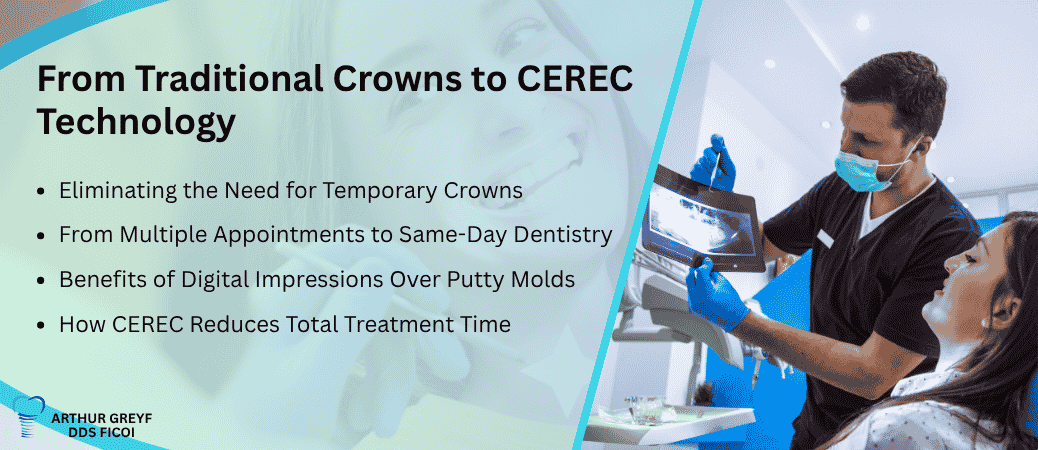
Eliminating the Need for Temporary Crowns
When you get a traditional crown, your dentist must place a temporary crown over your prepared tooth while a lab makes your permanent crown.
These temporary crowns are made from acrylic or composite materials that aren’t as strong as your final restoration.
Temporary crowns can cause several problems during the 1-3 weeks you wear them.
They may fall off when you eat sticky foods, crack if you bite down on something hard, or allow food and bacteria to get underneath.
Some people experience increased sensitivity to hot and cold temperatures with temporary crowns.
CEREC same-day crowns eliminate these concerns entirely. Your dentist designs, creates, and places your permanent crown during a single visit.
You never need to worry about a temporary crown coming loose or breaking before your next appointment.
From Multiple Appointments to Same-Day Dentistry
Traditional crowns require you to schedule and attend two separate appointments.
Your first visit involves tooth preparation, taking impressions, and placing a temporary crown. This appointment usually takes 45-90 minutes.
You then wait 1-3 weeks while a dental lab fabricates your crown. During this time, you need to be careful about what you eat and how you clean around the temporary crown.
Your second visit involves removing the temporary crown and cementing the permanent one. This takes another 30-60 minutes of your time.
Same-day CEREC crown appointments complete the entire process in one visit lasting 2-4 hours. You don’t need to take multiple days off work or arrange childcare twice.
The convenience of getting everything done at once appeals to many patients with busy schedules.
Benefits of Digital Impressions Over Putty Molds
Traditional dental impressions use putty-like materials that you must bite into while they harden.
Many people find this uncomfortable or even gag during the process. The putty can also distort slightly when removed from your mouth, affecting the accuracy of your crown.
CEREC uses a small digital camera to scan your prepared tooth instead.
The scanner captures thousands of images in just a few minutes to create a 3D model. You don’t have to deal with any unpleasant tastes or textures.
Digital scanning offers several advantages:
- No gagging or discomfort during impressions
- More accurate measurements of your tooth
- Immediate results that your dentist can review with you
- No waiting for impressions to set or ship to a lab
- Easy to retake if needed without starting over with new materials
The digital files also allow your dentist to design your crown more precisely to match your bite and neighboring teeth.
How CEREC Reduces Total Treatment Time
The time savings with CEREC add up quickly when you count both the appointment time and the waiting period.
Traditional lab-made crowns require you to spend about 75-150 minutes total in the dental chair across two visits, plus 1-3 weeks of waiting between appointments.
A CEREC crown takes 2-4 hours in one appointment. While this single visit is longer than either traditional appointment alone, you eliminate the second visit entirely.
You also avoid the weeks of wearing a temporary crown and the worry that comes with it.
Same-day dental crowns let you walk out with your permanent restoration the same day. Your tooth is fully restored and protected immediately.
You can eat normally as soon as the numbness wears off, without the restrictions that come with temporary crowns.
Materials and Quality: What Makes CEREC Crowns Durable and Natural-Looking?
CEREC crowns are made from high-quality ceramic materials that provide both strength and a natural appearance.
The combination of advanced esthetic ceramics and precise digital manufacturing creates dental restorations that are reliable and visually appealing.
Strength and Longevity of Esthetic Ceramics
CEREC crowns are made from strong ceramic materials like lithium disilicate or zirconia. These esthetic ceramics resist wear and damage from everyday use.
Research shows these crowns provide reliable tooth restoration that lasts for years.
The ceramic material used in CEREC technology is biocompatible with your mouth. This means your body accepts the crown without causing irritation or allergic reactions.
The ceramic is also resistant to staining from coffee, tea, and other foods.
CEREC crowns tend to be sturdy and resist abrasion, making them more likely to last.
The manufacturing process creates a dense, uniform structure that holds up well to chewing forces.
You can expect your CEREC crown to perform like a natural tooth for many years.
Cosmetic Benefits of Ceramic Crowns
Your CEREC crown will look natural because the ceramic material mimics real tooth structure.
Because it lacks a metal core, a CEREC crown tends to look more natural and more closely resembles the surrounding teeth.
Light passes through ceramic the same way it moves through natural enamel.
The ceramic crown material comes in various shades to match your existing teeth. Your dentist selects the right color during your appointment to ensure a perfect blend.
Most people won’t notice you have a crown because it blends in so well.
Key aesthetic advantages include:
- No dark metal lines at the gum line
- Natural light reflection and translucency
- Custom color matching to adjacent teeth
- Smooth, natural-looking surface texture
Choosing Between CEREC and Lab-Made Restorations
Both CEREC and traditional lab-made crowns use quality ceramic materials.
The main difference is how and where they’re created.
CEREC crowns have a lower cost of production because a single dentist can create the digital impression and mill the crown using technology during the same visit.
Lab-made crowns require multiple appointments and temporary crowns while you wait.
CEREC dental restorations are completed in one visit, eliminating the need for temporary crowns.
Cost is generally comparable to traditional lab-made crowns, typically $800 to $1,500 per crown.
Your dentist has complete control over the CEREC crown-making process from start to finish.
If adjustments are needed, your dentist can remake the crown quickly during your appointment. This level of control ensures you get the exact fit and appearance you need.
What to Expect at Your CEREC Appointment
Your CEREC appointment combines several steps into one visit, starting with tooth preparation and ending with a finished crown.
The dentist will prepare your tooth, take digital impressions, design your custom crown on a computer, and mill it right in the office.
Tooth Preparation and Digital Impression Process
Your dentist will start by numbing the area around your tooth with local anesthetic.
Once you’re comfortable, they’ll remove any decay and shape the tooth to make room for the crown.
After tooth preparation is complete, your dentist will use a digital scanner instead of traditional messy impression putty.
The scanner looks like a small camera that captures detailed 3D images of your prepared tooth.
You’ll feel the scanner moving around your mouth, but it won’t cause discomfort.
The scanning process takes about 10 to 15 minutes and creates a precise digital model of your tooth.
Your dentist might apply a light powder to your teeth first to help the camera get better images. You can often watch the 3D images appear on a screen in real time as your tooth gets mapped.
Computer-Aided Design and Computer-Aided Manufacturing
Once scanning finishes, your dentist uses computer-aided design software to create your crown.
They’ll adjust the virtual crown’s shape and size on a computer screen to match your natural teeth. The software suggests a design automatically, but your dentist fine-tunes it to fit properly against your other teeth.
After the design is complete, the information goes to the milling unit for computer-aided manufacturing. The machine uses diamond-coated tools to carve your CEREC crown from a solid ceramic block.
This process takes about 15 to 20 minutes and is very precise.
While your crown is being milled, you can take a break, use the restroom, or relax. The freshly milled crown comes out looking chalky white at first.
Your dentist will then smooth rough edges, add stains and glazes to match your natural tooth color, and polish it.
Ensuring Proper Bite Alignment and Fit
Before cementing your CEREC same-day crown permanently, your dentist will try it in your mouth to check everything.
They’ll test the fit where the crown meets your tooth, how it touches the teeth next to it, and your bite alignment when you close your jaw.
This is when you can tell your dentist how the crown feels. If something doesn’t feel right, speak up.
Minor adjustments are common and easy to fix with careful grinding.
Your dentist will check that the crown doesn’t sit too high or interfere with your normal bite.
Once the bite alignment feels comfortable and the fit looks good, they’ll cement the crown in place using dental adhesive.
You’ll bite down on a cotton roll for a few minutes while the cement hardens.
Who Should Consider CEREC Same-Day Crowns?
Not everyone is an ideal candidate for same-day restorations, and understanding when traditional lab-made crowns might be better helps you make the right choice for your dental health.
Finding a qualified provider with the right experience matters just as much as choosing the restoration method itself.
Good Candidates for Same-Day Restorations
You’re likely a good fit for a same-day CEREC crown if you need a single crown on a tooth that doesn’t require extensive gum work or bone grafting.
People with busy schedules who can’t easily take time off for multiple appointments benefit most from this option.
CEREC works well for restoring cracked, broken, or heavily decayed teeth in most areas of your mouth.
If you have a straightforward case where the tooth structure is solid and healthy below the gum line, same-day digital dentistry can give you excellent results.
You should also consider your comfort level with dental procedures. If you dislike temporary crowns or have had problems with them falling out in the past,
CEREC eliminates that concern entirely. You walk out with your permanent restoration the same day.
People who grind their teeth can still get CEREC crowns, though you’ll need to wear a night guard to protect your investment.
When Lab-Made Crowns Might Be Necessary
Complex cases often require the extra time and specialized skills that lab-made crowns provide.
If you need multiple crowns that must match perfectly, a dental laboratory can create restorations with more precise color blending across several teeth.
Front teeth where appearance is critical sometimes benefit from traditional crowns. Lab technicians have more time to layer different crown materials and create the exact shade variations found in natural teeth.
You might also need a lab-made option if your bite is complicated or if you require extensive gum recontouring before the crown placement.
A prosthodontist specializes in these complex restorations and can determine which approach works best.
Certain back teeth that handle extreme chewing forces may last longer with specific lab-created materials that aren’t available in CEREC blocks yet.
How to Find a Prosthodontist or Qualified Provider
Start by asking your regular dentist if they offer CEREC technology and how long they’ve been using it.
Experience matters significantly with digital dentistry, so you want someone who completes multiple same-day crowns each month.
If your case is complex, you should find a prosthodontist who specializes in crown and bridge work.
These specialists have advanced training in both traditional and digital restoration techniques.
They can evaluate your situation and recommend whether same-day or lab-made options suit your needs better.
Ask to see before-and-after photos of their CEREC work. A qualified provider will gladly show examples and explain their process.
Check online reviews specifically mentioning crown work and look for comments about the dentist’s attention to detail.
Don’t hesitate to schedule consultations with multiple providers to compare their experience levels and approaches to your specific case.
Cost, Insurance, and Longevity of CEREC Dental Solutions
CEREC crown cost typically ranges from $1,000 to $2,500 per tooth, similar to traditional ceramic crowns, while insurance covers same-day restorations at the same rate as lab-made options.
These permanent crowns last 10 to 15 years with proper care.
Breakdown of CEREC Crown Cost
Same-day crowns cost between $1,000 and $2,500 per tooth in 2026. This price range matches traditional all-ceramic crowns because the CEREC equipment investment offsets the lab fee.
Your location and dentist affect the final price. Urban practices often charge more than rural offices.
CEREC dental solutions don’t cost extra just because they’re made in one visit. The manufacturing method is different, but the material quality is the same.
Traditional porcelain-fused-to-metal crowns made in a lab cost $800 to $1,400, making them the cheapest option if price is your main concern.
The same-day restoration eliminates temporary crown fees and second appointments. You avoid taking additional time off work or arranging extra childcare.
Insurance Coverage Comparison

Your dental insurance covers CEREC crowns the same way it covers traditional crowns.
Plans classify coverage by clinical need and material, not by how the crown was made.
Most plans pay about 50% of the cost after you meet your deductible. If your CEREC crown costs $1,500, you’ll typically pay $750 out of pocket.
The insurance reimbursement doesn’t change whether you choose same-day or lab-made options.
Watch out for your annual maximum, which is usually $1,000 to $1,500. If you need multiple crowns or other major work in the same year, you might hit this limit.
Some plans have waiting periods of 6 to 12 months for major restorative work if you just enrolled.
Lifespan and Maintenance of Same-Day Crowns
CEREC permanent crowns last 10 to 15 years on average. This matches the lifespan of lab-made ceramic crowns.
Several factors affect how long your crown lasts. Back teeth with heavy chewing forces wear down faster than front teeth.
If you grind your teeth at night, it can not only damage your teeth but you’ll also shorten any crown’s life without a night guard.
Good oral hygiene extends your crown’s lifespan. Decay at the crown edge is the most common reason crowns fail early.
Brush twice daily and floss around the crown just like your natural teeth.
The ceramic material matters too. Lithium disilicate and zirconia blocks are the strongest options. These materials handle bite forces better than older ceramic types.
Root canal teeth with crowns are more fragile. The tooth structure is weaker, so the crown protects it but can’t prevent all fractures.
Frequently Asked Questions
CEREC technology completes your crown in 60-90 minutes using digital scanning and in-office milling.
Same-day crowns last 10-15 years or more, just like traditional crowns, and eliminate the need for temporary restorations.
How does a same-day dental crown work from start to finish?
Your dentist starts by numbing your tooth and preparing it by removing decay and shaping it for the crown.
This step takes about 15-20 minutes and works the same way as traditional crown preparation.
Next comes digital scanning instead of messy impressions. Your dentist uses a small scanner to capture thousands of photos per second and build a 3D model of your tooth.
You can watch the image appear on screen in real time.
Your dentist then designs your crown on a computer using special software. The design accounts for how your crown fits with neighboring teeth and your bite.
This customization takes 10-15 minutes.
The design gets sent to a milling machine right in the office. The machine carves your crown from a solid ceramic block in 15-20 minutes.
You’ll hear it working while you relax in the chair.
Your dentist polishes the crown and may add staining to match your natural teeth perfectly. Finally, they check the fit and bite before permanently bonding it to your tooth.
How long does it usually take to get a crown in one appointment?
A complete CEREC crown appointment typically takes 60-90 minutes from start to finish. This includes all steps from numbing your tooth to bonding your permanent crown.
The longest you’ll have your mouth open at one time is during digital scanning. That only takes 5-10 minutes.
While your crown is being designed and milled, you can take bathroom breaks or just relax.
You should plan for 90-120 minutes total for your appointment to account for check-in and any final adjustments.
This single longer visit replaces two or three shorter appointments spread over several weeks.
Will I need a temporary crown if my crown is made the same day?
No, you won’t need a temporary crown at all with CEREC. Your permanent crown gets placed during the same appointment. This is one of the biggest benefits of same-day crowns.
Temporary crowns can break, fall off, or leak bacteria onto your prepared tooth. They often don’t fit quite right and can be uncomfortable.
Same-day placement eliminates these problems completely.
You also avoid needing a second numbing appointment. Traditional crown patients get numbed twice, but you only need anesthetic once.
Are same-day crowns as strong and long-lasting as traditional crowns?
CEREC crowns typically last 10-15 years or more, which matches the lifespan of high-quality traditional crowns.
How long your crown lasts depends more on your oral hygiene and bite forces than where it was made.
The ceramic blocks used for milling are often stronger than other types of dental ceramics.
They’re carved from a solid, uniform piece rather than being layered or pressed. This creates a crown that can handle normal chewing forces.
Your crown’s longevity also depends on how well you care for it. Brush and floss normally, and avoid using your teeth to open packages or chew ice.
What should I expect during and after the appointment for a same-day crown?
During your appointment, the digital scanning process is much more comfortable than traditional putty impressions.
You won’t gag on impression material or wait for it to set. The scanner just takes photos of your tooth.
Most patients find the process interesting rather than stressful. You can watch your crown being designed on the computer screen.
You’ll hear the milling machine carving your crown in the background.
After your crown is bonded, you can eat normally once the numbing wears off in 2-3 hours. Avoid very hard or sticky foods for the first 24 hours while the bonding reaches full strength.
Your bite might feel slightly different for a few days as you adjust to the new crown. This is normal. Most patients forget they have a crown within a week.
Who is a good candidate for getting a crown made and placed in one visit?
CEREC works well for most patients who need a crown on a single tooth. You’re a good candidate if you prefer completing treatment in one visit rather than coming back multiple times.
Same-day crowns help if you’ve had problems with temporary crowns falling off or breaking in the past.
They’re also great if you have a sensitive gag reflex, since digital scanning is more comfortable than impression material.
CEREC uses ceramic materials, which work well for most situations.
However, very deep margins or certain complex bite relationships might need traditional lab-made crowns. Your dentist can tell you if CEREC is right for your specific case.